AI Can Find Small Businesses. So Why Does It Still Recommend the Big Guys?
New research shows that AI tools can find and cite small businesses while still recommending larger chains first. Here’s why that matters, and how clearer business information and platforms like SmallSpotter can help independent businesses become easier to discover.
For years, small businesses have been told that being visible online is the key to being discovered.
Build a website. Get listed in search engines. Keep your information accurate. Create useful content. Make it easier for customers to find you.
Those things still matter.
But new research suggests that the rise of AI search is creating another challenge for small businesses:
Being found by AI does not necessarily mean being recommended by AI.
That difference could become increasingly important as more people turn to tools like ChatGPT and Google's AI products instead of traditional search results when deciding where to shop or which businesses to use.
What the Research Found
A large study conducted by Vaer AI on behalf of Lightspeed Commerce analyzed roughly 460,000 AI-generated shopping responses and more than 2.4 million links.
Researchers tested more than 20,000 shopping prompts across ChatGPT, Google AI Mode, and Google AI Overviews.
The results showed a significant advantage for larger retailers.
When ChatGPT included retailer names while performing its own web searches, 97% of those retailers were large or mid-sized chains, while small and local retailers represented only about 1% to 4%.
But this is where the research gets especially interesting.
Small retailers weren't necessarily invisible.
Large and small retailers each represented roughly 38% of the sources AI ultimately cited.
Yet large retailers received approximately 52% of the top recommendations, compared with only 20% for smaller businesses.
In other words:
The AI could find the small business. It could use the small business as a source. And it could still recommend the larger company instead.
Being Cited Isn't the Same as Being Recommended
Imagine asking an AI assistant:
"Where can I buy office supplies in New York?"
The AI searches the web and finds several businesses, including a few independent stores and a national chain.
It may use information from all of them to create its answer.
But when it gives you its actual recommendation, the national chain might appear first.
That is essentially what researchers observed.
In one example discussed by Lightspeed CEO Dax Dasilva, three of the six sources ChatGPT cited were small local retailers, yet Staples became the first recommendation.
For a small business owner, that distinction matters.
A customer usually isn't studying every source an AI system used to create its answer.
They're looking at the businesses the AI actually tells them to consider.
As AI becomes another way people discover products and services, recommendation visibility may become just as important as traditional search visibility.
One Word Made a Surprising Difference
Researchers also tested what happened when shoppers changed the way they asked their questions.
They added the word:
"Independent."
That small change made a major difference.
Adding "independent" to shopping prompts more than doubled the number of small and local retailers AI named.
Lightspeed also reported that the share of recommendations going to large national chains dropped from about 44% to as little as 9% in follow-up testing.
That tells us something important.
AI systems may respond differently when they are given clearer information about what type of business someone wants.
A customer asking:
"Where can I buy handmade jewelry?"
may receive very different recommendations from someone asking:
"Where can I buy handmade jewelry from an independent local business?"
The second question gives the AI more context.
And small businesses can learn something from that.
Small Businesses Need to Clearly Say What They Are
A small business owner knows they're independent.
Their regular customers know it.
Their community may know it.
But an AI system doesn't automatically understand a business the way a person does.
It depends on information available across websites, directories, business profiles, and other online sources to understand questions such as:
- Is this an independent business?
- Is it owner-led?
- What does it specialize in?
- Where does it operate?
- Does it serve customers locally, remotely, or both?
- What products or services does it actually provide?
The clearer and more consistent those answers are across the web, the easier it becomes for search engines and AI systems to understand what makes that business relevant.
This is one of the reasons SmallSpotter exists.
Where SmallSpotter Fits
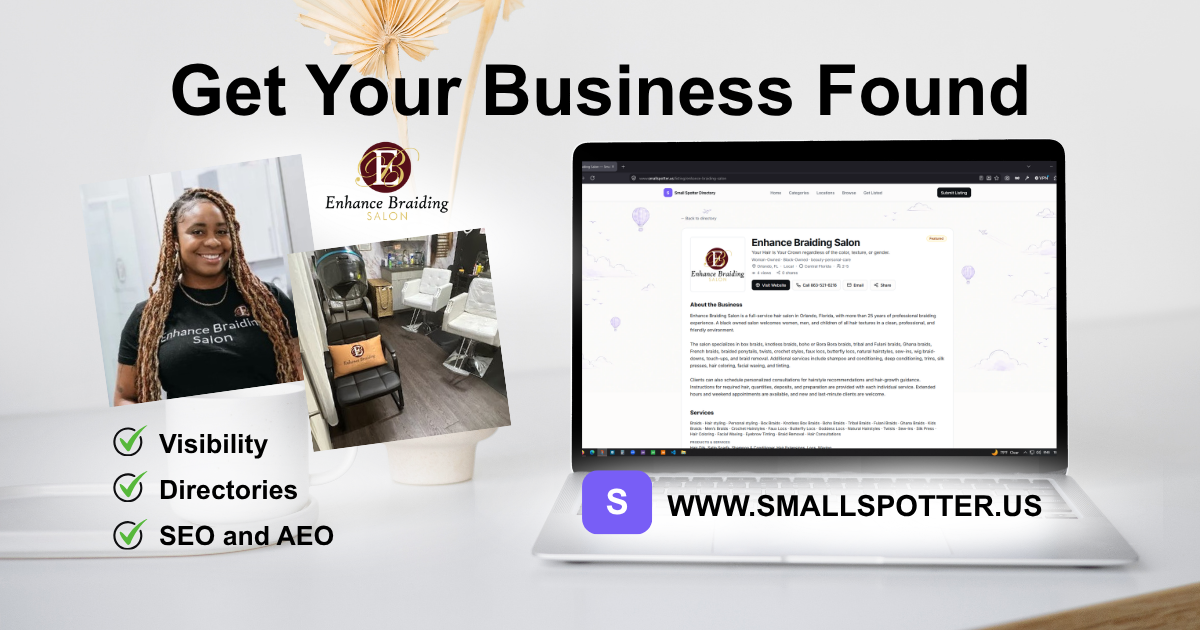
SmallSpotter was created specifically to help people discover smaller, owner-led businesses across the United States.
Instead of placing a small company inside a massive directory alongside national chains, SmallSpotter focuses on businesses with fewer than 50 employees and emphasizes the information that helps explain what makes each business different.
A SmallSpotter listing can clearly identify things such as:
- Business category
- Services
- Location or service area
- Local, mobile, or remote availability
- Business specialties
- Owner-led status
- Business description
- Website and contact information
That information helps customers browsing SmallSpotter.
But it also creates another clear source on the web describing:
What the business is.
What it does.
Where it operates.
Who it serves.
That distinction is becoming increasingly important.
SmallSpotter cannot guarantee that ChatGPT, Google, or another AI system will recommend a particular business.
No directory can honestly make that promise.
What SmallSpotter can do is help small businesses create a clearer digital presence and make information about them easier to understand and discover.
Think Beyond Traditional SEO
For years, businesses have focused on SEO, or Search Engine Optimization, because they wanted to appear higher in Google search results.
Now another idea is becoming important:
Making sure AI systems can clearly understand a business well enough to include it when answering a question.
You may hear this called AEO, Answer Engine Optimization, or GEO, Generative Engine Optimization.
The terminology can sound complicated.
The basic idea isn't.
Small businesses need clear information online that answers questions customers might ask.
Instead of simply saying:
"We provide high-quality solutions for all your needs."
say what you actually do.
For example:
"Owner-led bookkeeping service helping small businesses in Richmond, Virginia with monthly bookkeeping, QuickBooks cleanup, and financial reporting."
The second description gives both people and machines substantially more information to work with.
It explains:
- What the business does
- Who it serves
- Where it operates
- What services it offers
- What makes it relevant
What Small Businesses Can Do Now
You do not need to completely rebuild your website for AI.
Start by making your business easier to understand.
Clearly Describe What You Do
Avoid vague marketing language.
Instead of:
"Helping businesses reach their full potential."
try something more specific:
"Business consultant helping independent retail businesses improve operations, pricing, and customer retention."
Include the Locations You Serve
If your business serves Richmond, Chesterfield, and Petersburg, say that.
If you work nationwide remotely, say that too.
Identify What Makes Your Business Different
If you are:
- Independent
- Owner-led
- Locally owned
- Family owned
- Mobile
- Remote
- Specialized in a particular service
make that information clear where appropriate.
Keep Your Business Information Consistent
Your business name, website, location, services, and other important details should be consistent across your website and reputable business directories.
Create Useful Listings Beyond Your Own Website
Your own website should remain your primary source of information.
But accurate listings on relevant platforms can create additional references that help customers, search engines, and AI systems better understand your business.
Don't Assume Being Indexed Means Being Recommended
Being crawled by Google or discovered by an AI system is only part of the challenge.
The Lightspeed research suggests there may already be a meaningful gap between:
Being discovered
and
Being chosen.
Small Businesses Deserve to Be Part of the Answer
There is some encouraging news in the research.
Consumers appear interested in finding smaller businesses.
In Lightspeed's accompanying survey of 2,000 North American consumers, 50% said they would be more likely to shop locally if AI made nearby independent retailers easier to discover.
When asked what AI should prioritize:
- 33% chose small or local businesses
- Only 13% preferred large brands
The demand is there.
The challenge is helping those businesses make it into the conversation.
That's the larger mission behind SmallSpotter.
Small businesses shouldn't have to become national brands before technology considers them worth recommending.
Sometimes the best answer isn't the biggest company.
Sometimes it's the independent designer, neighborhood retailer, local caregiver, consultant, contractor, maker, or owner-led company that happens to be exactly what someone was looking for.
SmallSpotter is helping make those businesses easier to spot.